
This post contains affiliate links. If you purchase through these links, I may earn a small commission at no extra cost to you. I only recommend products I’ve personally researched and believe are worth your money.
📱 Watch the Short
Prefer a quick summary? Watch the 30-second version on YouTube.
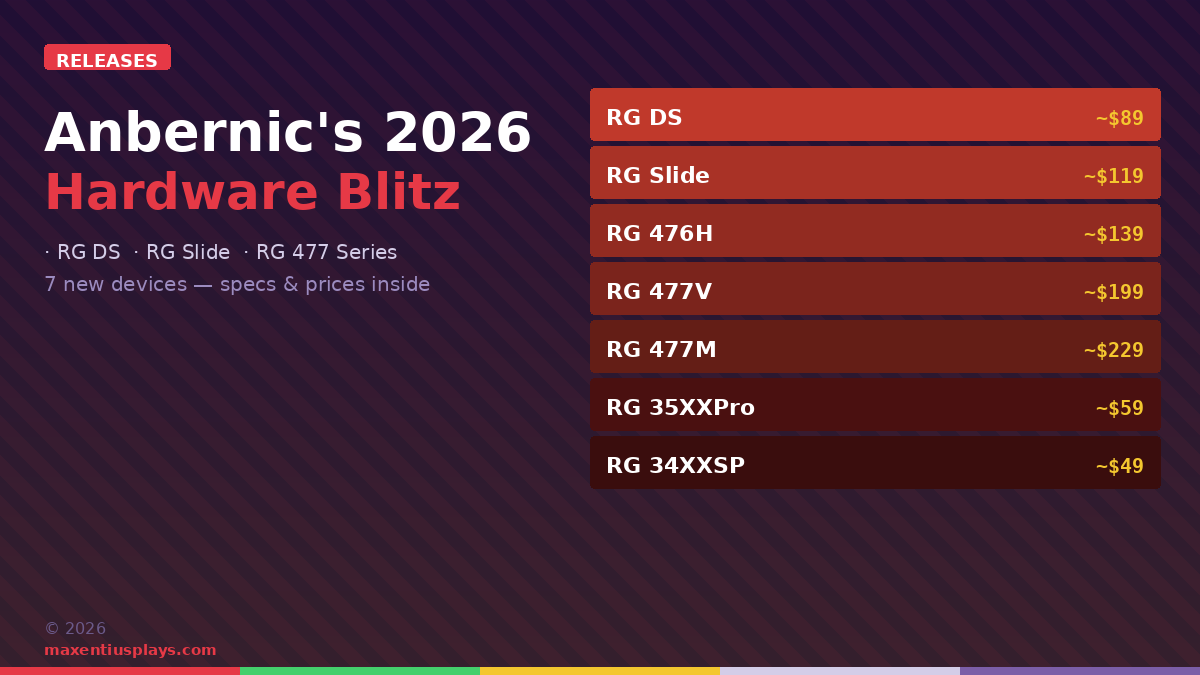
If you blinked in the past few weeks, you might have missed Anbernic quietly listing nine new devices on their website. That’s not a typo — nine. The Chinese manufacturer has been firing on all cylinders with a product blitz that spans from a $49.99 budget Linux handheld all the way up to $269.99 Dimensity 8300 flagships, with some genuinely strange and interesting form factors in between. Let’s break down everything new on Anbernic’s 2026 lineup, with verified specs and pricing pulled directly from their site.
RG DS — Dual Screens, Android 14, and a Stylus for $94.99
The most immediately eye-catching new Anbernic device isn’t a powerhouse — it’s the RG DS, which does exactly what its name implies: two screens, Nintendo DS-style, in a clamshell form factor. It runs Android 14, includes a capacitive stylus, and comes in at $94.99 (with optional 128GB and 256GB SD card bundles available).
The RG DS is designed for players who want to emulate the Nintendo DS library in native dual-screen mode — a niche that has always been underserved. Most Android handhelds require you to choose between stretching the DS display or cramming both screens into one small panel. With the RG DS, you get actual dedicated screens for top and bottom display, which is the way the DS was meant to be played. The stylus support adds touch controls for DS games that relied on them.
On the spec side, Anbernic hasn’t published full hardware specifications beyond Android 14 and stylus support. Considering the price point sits below the mid-range tier, expect something in the Unisoc T618 or H700 ballpark — capable of DS, GBA, SNES, and PSP without breaking a sweat, but not a PS2 machine. It ships in Black & Crimson Red, Turquoise Blue, and Polar White.
This is the device that will interest niche collectors and DS library enthusiasts most. If Anbernic has gotten the hinge and dual-screen alignment right, this could become a go-to recommendation for anyone specifically looking to play DS in the most authentic way possible on modern hardware.
→ Anbernic RG DS — Official Store
RG Slide — A Slider Form Factor Returns
The RG Slide is another form-factor oddity in the best possible way. It features a sliding mechanism — the controls slide out from behind the screen, giving you a device that pockets like a smartphone but unfolds into a proper gaming handheld. The Slide runs Android 13 on a Unisoc T820 chip (6nm EUV, octa-core with 1×A76 at 2.7GHz + 3×A76 at 2.3GHz + 4×A55 at 2.1GHz), backed by 8GB LPDDR4X RAM and 128GB UFS2.2 storage.
The display is a 4.7-inch LTPS In-Cell panel at 1280×960 resolution with OCA full lamination and 120Hz refresh rate — a genuinely strong screen for this price tier. Battery is 5000mAh with an estimated 6 hours of gaming, and there’s support for TF card expansion up to 2TB. Anbernic is also pushing a built-in AI assistant feature (one-click game guides, real-time translation, text-to-image generation) that they’re clearly positioning as a differentiator.
The Unisoc T820 is a capable mid-range chip — expect solid PS1, N64, Dreamcast, PSP performance, and decent PS2 on optimized titles. It’s not going to challenge the RK3576 on heavy emulation, but at $149.99 (currently on sale from $189.99) you’re getting a unique form factor with a very good screen.
→ Anbernic RG Slide — Official Store
RG 476H — Mid-Range Android with a 120Hz Display
The RG 476H shares its specs closely with the RG Slide — same Unisoc T820 processor, same 4.7-inch LTPS 1280×960 120Hz display, same 8GB RAM and 128GB UFS2.2 storage, same 5000mAh battery, Android 13. The key difference is the form factor: this is a traditional horizontal handheld layout rather than a slider.
At $154.99 (on sale from $164.99), the RG 476H slots in as Anbernic’s standard mid-range Android offering with a noticeably better screen than previous devices in this price bracket. The 120Hz panel at 1280×960 is a solid upgrade over the 60Hz displays that have been standard at this tier. Colors are Black, Indigo, and Retro Gray — the Indigo variant is particularly sharp looking.
If you just want a capable horizontal Android handheld at the ~$150 mark and don’t need the slider gimmick, the RG 476H is the straightforward pick.
→ Anbernic RG 476H — Official Store
RG 477V and RG 477M — Dimensity 8300 Enters the Lineup
At the top of the new lineup sit two variants of the RG 477 series, both powered by the MediaTek Dimensity 8300. The Dimensity 8300 is a significant step up from anything Anbernic has shipped before — a 4nm chip with an octa-core CPU (4×Cortex-A715 + 4×Cortex-A510) and Mali-G615 GPU that brings genuine PS2 and GameCube emulation into comfortable territory.
The RG 477V is the vertical-form variant, from $239.99 (8GB/128GB), with a 12GB/256GB configuration also available. It features Anbernic’s custom 120Hz high-refresh display and is described as the smoothest gaming experience in their lineup.
The RG 477M goes one further with a premium metal body and leads with the 12GB/256GB configuration at $239.99 (currently on sale from $269.99 for certain configurations). The metal shell is a first for Anbernic at this price point — builds that have previously required stepping up to Retroid or AYN territory. Silver Blade and Chocolate Bronze color options add to the premium feel.
Both are strong competitors in the $230–$270 Android handheld space that until recently was dominated by the Retroid Pocket 5 and AYN Odin 3. With AYN having raised prices on their devices recently, the timing of these two releases is notable.
→ Anbernic RG 477V — Official Store
→ Anbernic RG 477M (Metal) — Official Store
Budget and Clamshell: RG 35XXPro and RG 34XXSP
Completing the lineup are two familiar form factors with fresh branding. The RG 35XXPro ($49.99) is Anbernic’s latest entry in the RG35XX family — the same H700 quad-core Cortex-A53 chip, 3.5-inch IPS screen at 640×480, 1GB RAM, and Linux-based system. Three colors (Transparent Teal, White, Black) and dual microSD slots. If you want a dead-simple, affordable device for GBA, SNES, NES, and Genesis emulation, the RG35XX line has been reliably excellent and the Pro variant continues that tradition.
The RG 34XXSP ($67.99) is the clamshell answer — a GBA SP-inspired design with a 3.4-inch IPS screen at 720×480, same H700 CPU, Linux, 3300mAh battery, and the satisfying fold-and-click of a clamshell form factor. It comes in Yellow, Gray, Black, and Indigo. If you’ve ever wanted to play GBA games on hardware that feels like a GBA SP — right down to the hinge — this is the obvious pick.
→ Anbernic RG 35XXPro — Official Store
→ Anbernic RG 34XXSP — Official Store
Where Does This Leave the Market?
Nine new Anbernic devices in one window is a lot to absorb. The big picture takeaway: Anbernic is no longer just competing in the budget-to-mid tier. With the Dimensity 8300-powered RG 477 series, they’re going after Retroid and AYN directly at $240–$270 — and doing so at a moment when AYN has just raised prices. The addition of the metal-body RG 477M is a direct answer to criticisms that Anbernic’s premium builds felt less substantial than the competition.
The RG DS and RG Slide are the wild cards. Form-factor experiments don’t always pan out — the slider and dual-screen designs are genuinely interesting but the proof will be in the hardware execution and community reception once devices are in hand. Watch r/SBCGaming and GBATemp in the coming weeks for first hands-on reports.
We’ll have dedicated follow-up coverage as devices start landing with reviewers. In the meantime, our Best Retro Handheld 2026 guide has the current landscape in full.
Leave a Reply