
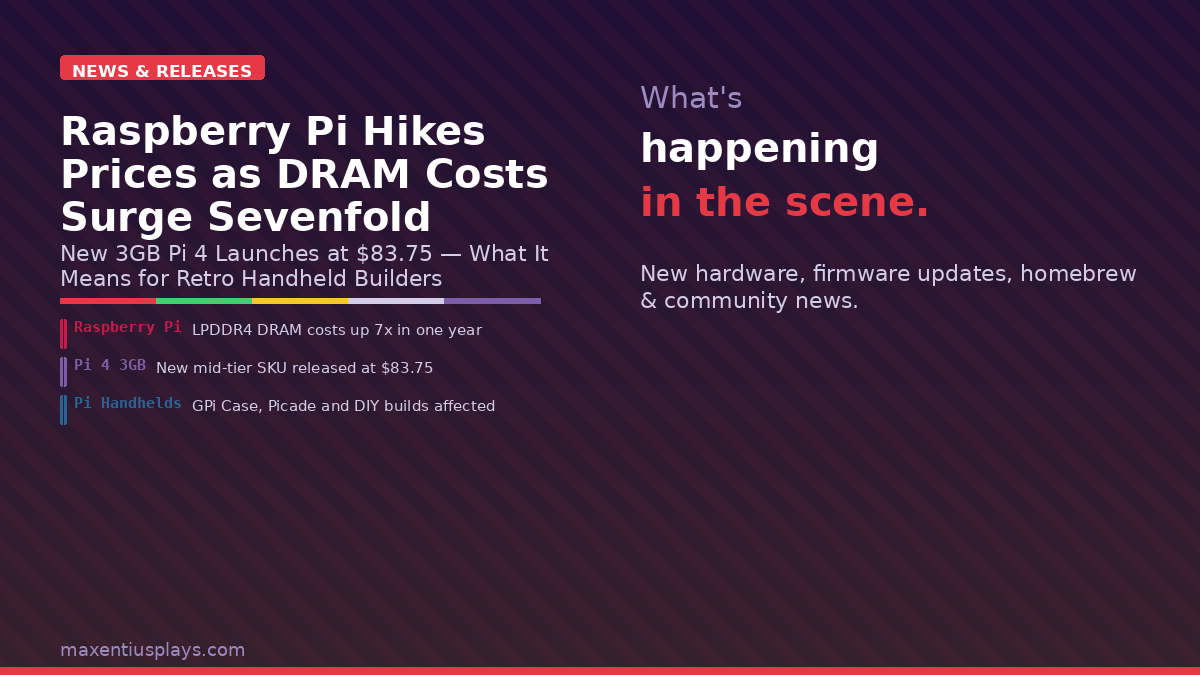
If you’ve been planning a Raspberry Pi-based retro handheld build — whether that’s a RetroFlag GPi Case 2, a Picade, or a fully custom Pi Zero 2W pocket machine — there’s news that affects your budget: Raspberry Pi Ltd has announced another round of price increases across its product lineup, effective today.
📱 Watch the Short
Prefer a quick summary? Watch the 30-second version on YouTube.
The culprit is the same one hurting everyone in the semiconductor space right now: memory prices. According to the company, the cost of LPDDR4 DRAM — the memory used in Raspberry Pi 4 and Raspberry Pi 5 — has risen sevenfold over the past year. That’s an extraordinary spike, driven by global supply tightening and increased demand across AI and embedded computing markets.
A New 3GB Mid-Tier Option
Alongside the price adjustments, Raspberry Pi is introducing a new memory tier: the Raspberry Pi 4 Model B with 3GB of RAM, priced at $83.75. This slots between the existing 2GB and 4GB variants, giving buyers a new mid-range option. The company is upfront that its goal is to let customers “not pay for more memory than you need” — essentially acknowledging that the jump from 2GB to 4GB has become a harder pill to swallow at current DRAM prices.
The 3GB Pi 4 is available now from Raspberry Pi Approved Resellers worldwide.
What Does This Mean for Retro Handheld Builders?
For the retro gaming community, Raspberry Pi boards are foundational hardware. Here’s a quick rundown of who this affects:
- RetroFlag GPi Case 2 (CM4 edition): Uses the Raspberry Pi Compute Module 4. CM4 pricing has also been subject to ongoing fluctuation. If you’ve been sitting on the fence about a GPi Case 2 build, this is a signal that prices aren’t heading back down anytime soon.
- Pi Zero 2W builds: The Pi Zero 2W is a different chip (RP3A0, with LPDDR2 SDRAM) and may be less directly impacted, but reseller pricing tends to creep up in sympathy with broader Pi price movements.
- Picade and Pimoroni kits: These desktop/tabletop arcade builds using Pi 4 will carry higher board costs going forward.
- Custom handhelds: Anyone sourcing Pi boards for DIY projects via Approved Resellers like PiShop, Adafruit, or CanaKit will see higher prices on restocked inventory.
The Bigger Picture: Is Pi-Based Retro Gaming Getting Too Expensive?
It’s a fair question. When the Raspberry Pi 4 launched in 2019, the 2GB variant was $35. Today, memory inflation has pushed pricing into territory that competes directly with purpose-built retro handhelds from Anbernic, Miyoo, and TRIMUI — devices that come with a screen, buttons, battery, and custom Linux firmware, for $50–$100.
For pure emulation performance and community ecosystem, the Pi still has advantages: a massive library of RetroPie/Batocera guides, first-class support for unique form factors like the GPi Case 2, and future-proofing if you want to run more demanding emulation over time. But the value proposition for casual builders has narrowed considerably.
The one silver lining: the new 3GB SKU at $83.75 is a genuine improvement for builders who were paying full 4GB prices for tasks that don’t need 4GB. Running RetroPie or Batocera comfortably doesn’t require 4GB — 2GB has always been the floor for a capable build, and 3GB gives a comfortable headroom buffer without the top-tier premium.
Raspberry Pi’s Commitment to Accessible Computing
To their credit, Raspberry Pi explicitly frames these increases as something they’re engineering around — not just passing through. They’re expanding memory density options specifically to give buyers more choice and avoid paying for capacity they don’t use. Whether future SKUs or cost-optimized chips are in the pipeline remains to be seen, but the messaging is at least pointed in the right direction.
The official announcement notes: “Providing low-cost general-purpose computing remains a non-negotiable priority for us at Raspberry Pi, so while we can’t avoid passing on a portion of these increased costs, we’re also doing engineering work to expand the range of memory-density options.”
Bottom Line
If you’re building a Pi-powered retro handheld in 2026, factor in higher board costs. The new 3GB Pi 4 at $83.75 is worth considering if your build doesn’t need the full 4GB. And if you’re on the fence between a Pi build and a dedicated Chinese retro handheld, the price gap has gotten narrower — purpose-built devices like the Miyoo Mini Plus or TRIMUI Smart Pro are increasingly compelling value propositions for pure emulation use.
We’ll keep an eye on CM4 pricing as well, which is critical for the GPi Case 2 community. For now, plan your builds accordingly.
Source: Raspberry Pi official blog
Affiliate disclosure: Some links in this post may be affiliate links. If you purchase through them, we may earn a small commission at no extra cost to you. This helps keep Maxentius Plays running.
Leave a Reply