
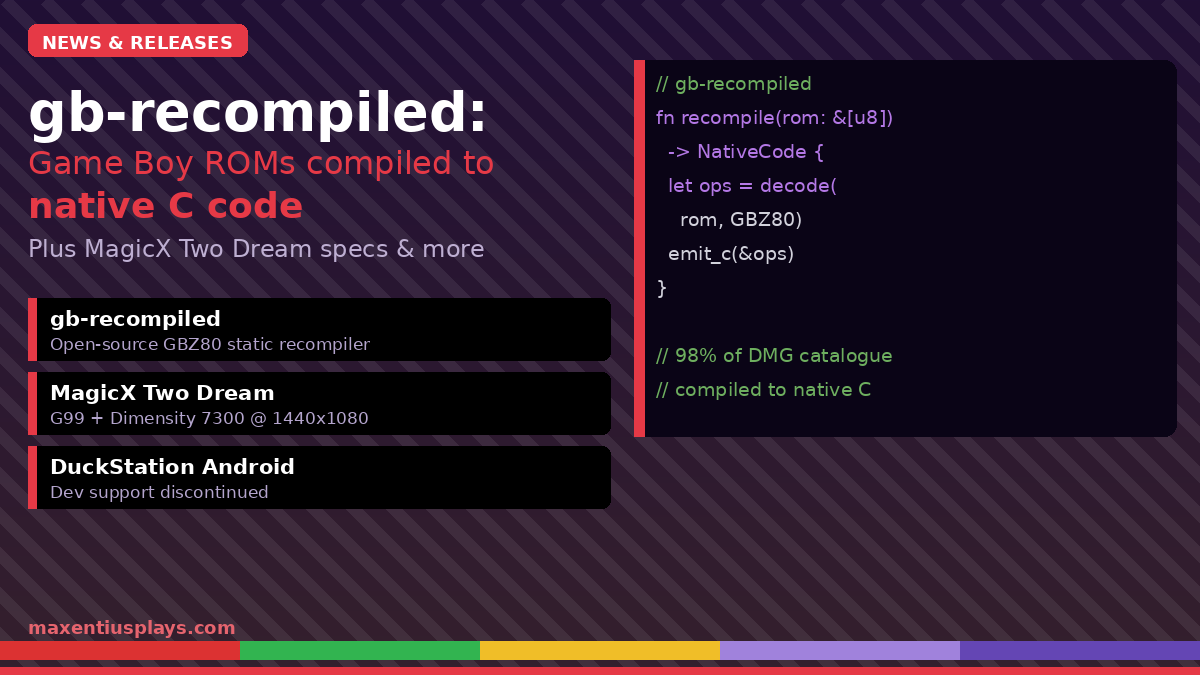
A busy few days in the retro handheld space. A new open-source tool is doing something nobody asked for but everyone secretly wanted — turning Game Boy ROMs into native C code — while MagicX has finally revealed the chips powering the upcoming Two Dream handheld lineup, and DuckStation’s Android future looks murkier than ever.
📱 Watch the Short
Prefer a quick summary? Watch the 30-second version on YouTube.
gb-recompiled: Game Boy ROMs Reborn as Native Binaries
Developer arcanite24 has released an open-source static recompiler for original DMG Game Boy titles. It takes a ROM, translates the Sharp LR35902 CPU instructions into portable C code, and builds a small runtime around it so the game runs as a native binary on your host system — no emulator required.
Instead of emulating the Game Boy hardware, gb-recompiled converts the ROM’s logic into a program your modern CPU executes directly. It’s the same conceptual approach as the celebrated N64 recomp projects and recent PS2 static recompiler work, just applied to 8-bit Nintendo hardware from 1989.
What It Does (And What It Doesn’t)
The dev reports approximately 98% of the Game Boy ROM catalogue has been compiled — but that doesn’t mean 98% of games work. Static recompilation on the Game Boy is genuinely hard. Dynamic jumps, self-modifying code, timing dependencies, and the enormous variety of ROM hacks and homebrew all conspire against clean translation. Some games boot fine, others are partially playable, and a fair number glitch spectacularly. It’s a work in progress, not a drop-in emulator replacement.
It’s worth noting: Game Boy emulation is already effectively solved. SameBoy and Gambatte are cycle-accurate and run everything. So this isn’t about performance. It’s about the nerdery of the thing — and about what a working static recompiler could unlock downstream.
Why Homebrew Developers Should Pay Attention
Static recompilation requires building a precise model of code flow through the CPU — every jump, call, and return path. The analysis work arcanite24 has done to process 98% of the known ROM library is a substantial automated survey of Game Boy code structure: commercial game patterns, edge cases in unofficial carts, control-flow signatures of different dev toolchains.
That body of work could feed into improved disassemblers, better ROM analysis tools, or future decompilation projects for specific titles. For anyone curious how their own homebrew interacts with a static analysis pass, now there’s a tool to throw it at.
Open source — pull requests welcome. Compatibility improves with each update.
MagicX Two Dream Light and Pro: Core Specs Revealed
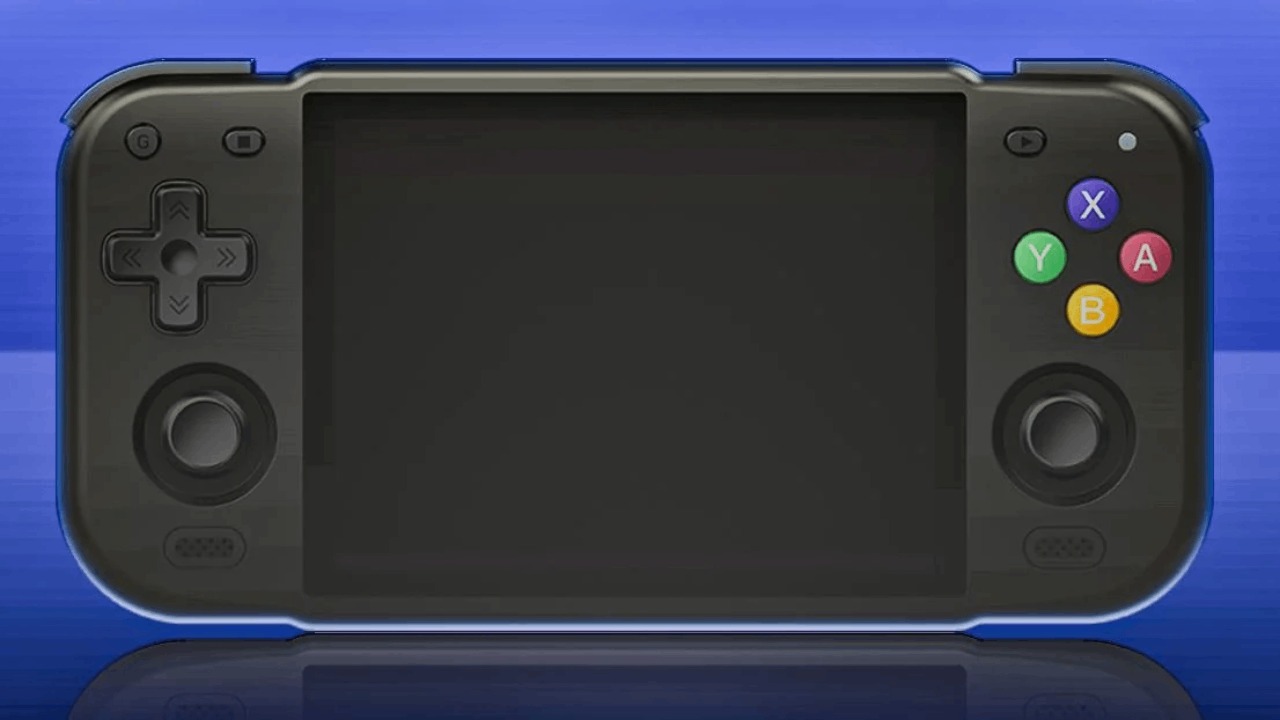
MagicX dropped the core hardware specs for its Two Dream lineup via Discord this week. Here’s what we know so far:
Two Dream Light
- Display: 4.5-inch, 1440×1080
- SoC: MediaTek Helio G99
- RAM / Storage: 3GB / 32GB
- Controls: Hall effect sticks and triggers
- Extras: Gyroscope, rumble, microphone
Two Dream Pro
- Display: 4.5-inch, 1440×1080
- SoC: MediaTek Dimensity 7300
- RAM / Storage: 4GB / 64GB
- Controls: Hall effect sticks and triggers
- Extras: Gyroscope, rumble, microphone
The Helio G99 in the Light is a known quantity — it powers the Miyoo Flip, Anbernic RG405V, and several other mid-tier Android handhelds. It handles everything through PS2 and light GameCube emulation. The Dimensity 7300 in the Pro is a meaningful step up with a more recent fabrication node and better sustained performance.
Still missing: battery capacity, charging speeds, OS, pricing, and release date. MagicX has said it is done with pre-sales and crowdfunding gimmicks, which is refreshing — but means no timeline until units are ready to ship. With the TrimUI Smart Pro S and Anbernic’s RG Vita series competing in the same $75–$150 bracket, MagicX will need to come in sharp on price.
No pricing or release date yet — watch this listing for updates when MagicX announces availability.
DuckStation on Android: Effectively on Life Support
The developer of DuckStation has effectively ended active support for the Android build following burnout and sustained community drama. The app still exists and works — nothing has been pulled — but meaningful updates are off the table and Android-specific issues won’t get attention going forward.
If you’re on an Android handheld and need PS1 emulation with an active development trajectory, it’s time to migrate. RetroArch’s PCSX ReARMed or Beetle PSX HW cores are well-supported on ARM Android and handle the vast majority of the PS1 library. ePSXe remains a solid standalone option as well. The Windows, macOS, and Linux builds of DuckStation remain active — this is strictly an Android casualty.
Quick Hits
- AYANEO Pocket Fit Elite is targeting March 17th production start with late-March shipments. No wider retail availability confirmed yet.
- AYANEO AYAWindow privacy concerns are circulating after reports the companion software may be capturing background screenshots and transmitting data. Nothing confirmed, but worth monitoring.
- Nintendo is suing the US government over Switch 2 tariffs, demanding refunds plus interest. The retro community watches with popcorn.
Sources: GBATemp · Retro Handhelds · MagicX Discord
Affiliate disclosure: Maxentius Plays may earn a commission on qualifying purchases made through links on this site at no extra cost to you.
Leave a Reply